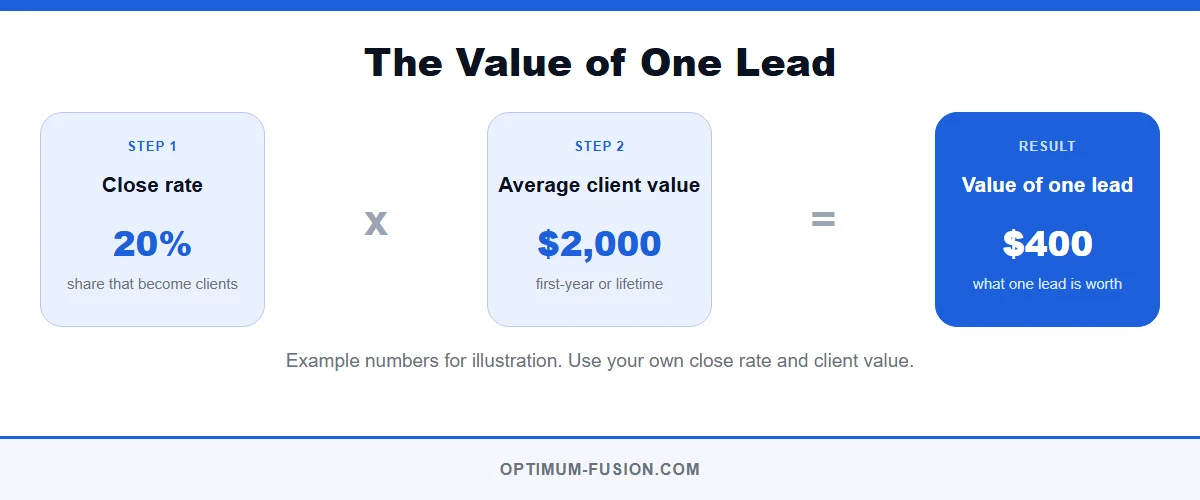
The short answer: the cost of a lost lead is your close rate multiplied by your average client value. If you close 20% of leads and a client is worth $2,000, every lead is worth $400, so every lead you never follow up with costs you up to $400.
The steps below show how to work out your own number and find where your leads are dropping off.
You only need a spreadsheet and your last 30 to 90 days of inquiries. If you want a ready-made one, download our free Lost Lead Calculator and Lead Audit (Excel, four tabs). Every formula in this post is already built in.
Step 1: How to calculate the cost of a lost lead
Start with three numbers from your own business:
| Number | What it means | If you do not track it |
|---|---|---|
| Leads per month | Every form fill, call, message and booking request | Count the inquiries in your inbox, phone log and calendar for the last 30 days |
| Close rate | The share of leads that become paying clients | Divide the clients you won in the last 90 days by the leads you got in the same 90 days |
| Average client value | What a new client is worth to you | Use the first-year revenue from your last 10 clients, averaged |
The value of one lead is close rate multiplied by average client value.
Example (made-up numbers for illustration): you get 40 leads a month, you close 20% of them, and a client is worth $2,000. Each lead is worth 0.20 × $2,000 = $400. All 40 leads are worth $16,000 a month.
Step 2: How many leads never got a real follow-up
Now look at the leads that went nowhere. Do not count the ones who said no. Count the ones nobody followed up with properly:
- No reply, or a reply days later
- A booked call that did not happen, with no reschedule attempt
- A call that happened, with no second touch afterward
- An old inquiry nobody has contacted in months
Continuing the example: if 12 of the 40 leads each month fell into one of these groups, that is 12 × $400 = $4,800 a month in lead value that was never worked. Over a year, that is $57,600.
This is not money you lose in full. Some of those leads would never have bought, and leads that go cold usually close at a lower rate than fresh ones. The figure is the upper limit: the value of leads you paid to get and then did not work.
A realistic recovery estimate: you will not recover all of it, so work with a fraction. If you win back one in four of those leads, that is 25% of $4,800, or $1,200 a month and $14,400 a year, with no new ad spend. Change the fraction to match what you think is realistic.
Step 3: How to find where leads drop off (the 30-minute audit)
Open your last 30 to 90 days of leads. For each one, record four things:
| Record | What to write |
|---|---|
| Source | Website form, call, social message, referral or ad |
| Time to first reply | Minutes, hours or days. Write “none” if there was no reply |
| Last touch | What you did last, and when |
| Outcome | Won, lost, or “nothing recorded” |
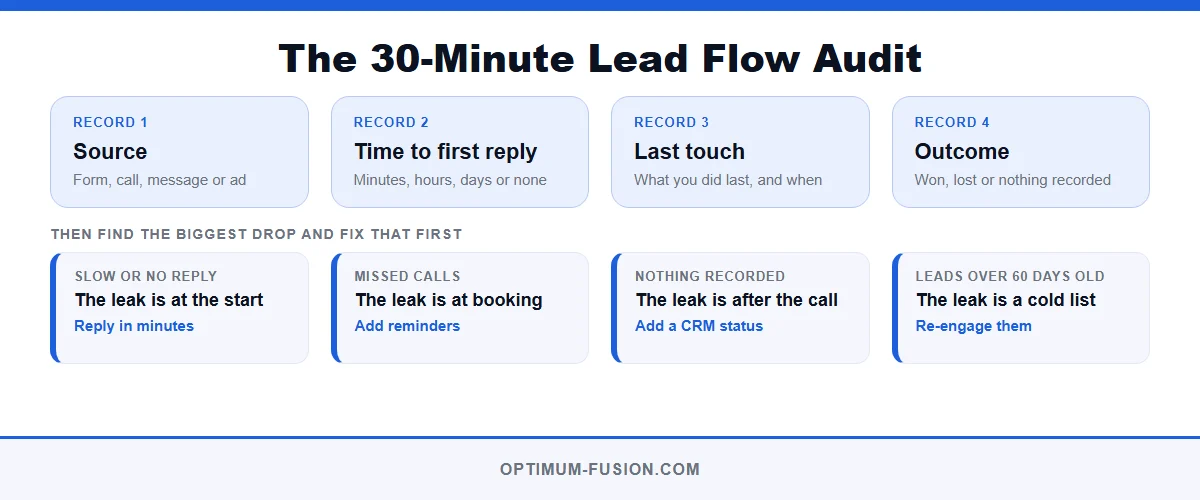
Then look for the stage with the biggest drop:
| If you see this | The leak is | Start here |
|---|---|---|
| Many “none” or slow first replies | At the start | Read speed to lead |
| Many booked calls with no show | At the booking | Read how to reduce no-shows |
| Many “nothing recorded” outcomes | After the call | Add tracking and a second touch (see Step 4) |
| Many leads older than 60 days with no contact | A cold list you already own | Read how to win back old leads |
If you cannot fill in the table because the data is not recorded anywhere, that is also an answer. It means nothing in your system tracks what happens to a lead after they reach out.
Step 4: How to fix the biggest leak first
Do not try to fix everything. Pick the one stage with the largest drop and fix only that.
- Slow first reply: send an automatic confirmation by text and email within minutes of a form fill or booking.
- No-shows: add reminders before the call, and an automatic reschedule message if they miss it.
- No tracking: give every lead a status (new, contacted, booked, won, lost) inside a CRM, so nothing sits unlabeled.
- Cold leads: schedule a short follow-up sequence that runs after a set number of quiet days.
Two texts you can copy and adapt:
First reply, sent right after a form fill:
Hi [Name], thanks for reaching out to [Business]. We got your message about [topic] and will reply personally by [time]. If it is urgent, call us at [number].
Missed call, sent right after the call is missed:
Hi [Name], sorry we missed your call. We can talk now or book a time that suits you here: [link].
How we run it ourselves: for our own booking system we built automatic confirmations, a one-hour reminder for both the client and the team member, and automatic tagging once a call ends, so nobody has to remember a step. The same approach works for any small business, and each part can run on its own.
For the wider list of warning signs, see 5 signs your business is losing leads.
Step 5: How to check that the fix worked
Run the same audit after 30 days. Compare three things: time to first reply, the number of leads with a recorded outcome, and your close rate. If one number moved, you found a real leak. Then move on to the next one.
Checklist: what to do this week
- Work out your close rate and average client value.
- Count the leads from the last 30 to 90 days.
- Record source, first reply time, last touch and outcome for each.
- Find the stage with the biggest drop.
- Fix that one stage only.
- Re-run the audit in 30 days.
Free download: Lost Lead Calculator and Lead Audit (Excel)
Enter your numbers, log your leads, and the formulas show your cost of lost leads, your biggest leak and what to fix first. The numbers inside are made-up examples: replace them with your own.
Frequently asked questions
What is the cost of a lost lead?
It is the close rate multiplied by the average client value. With a 20% close rate and a $2,000 client, each lost lead costs up to $400.
How do I calculate how much money I lose from missed leads?
Multiply the number of leads that got no real follow-up each month by the value of one lead, then multiply by 12 for a yearly figure. Treat the result as an upper limit, because some of those leads would never have bought.
What is lead leakage?
Lead leakage is when people who already showed interest, by filling a form, calling or booking, drop out of your process before they become clients, usually because follow-up was slow, missing or not tracked.
How do I find out where my leads drop off?
Record the source, time to first reply, last touch and outcome for every lead from the last 30 to 90 days. The stage with the most “none” or “nothing recorded” entries is your biggest leak.
How long does it take to fix a lead follow-up system?
The audit takes about 30 minutes. Fixing the single biggest leak, such as an automatic first reply or appointment reminders, is usually a small setup, and you can re-check the results after 30 days.
Want help finding your leak?
At Optimumfusion we build lead follow-up systems for small businesses: confirmations, reminders, tracking and re-engagement that run on their own. If you would like a second set of eyes on your numbers, book a free 30-minute strategy call and bring your lead list. We will look at it with you.