
Portfolio / Healthcare
Two healthcare platforms for chronic care and remote monitoring.
A US healthcare group runs care management programs for physician practices across the country. We built the two platforms its clinical team works in every day: one for Chronic Care Management, and one for Remote Patient Monitoring, where readings from patients' home devices arrive and the right nurse or provider is alerted.
- Client
- Healthcare management group, United States
- Services
- Web and app development, data engineering, reporting
- Built with
- Ruby on Rails, Flutter, SQL database on Google Cloud, Power BI
- Compliance
- HIPAA-compliant platforms
At a glance
The problem
Care that happens between visits.
Monthly work for every patient
Chronic Care Management is a Medicare program for people with two or more long-term conditions. Each enrolled patient needs care coordination every month, and the time spent has to be recorded.
Readings that can't wait
In Remote Patient Monitoring, patients take readings at home. Someone has to see them quickly and act when a number is out of range.
Proof of the work
Patients must agree before they are enrolled, and practices need clear reports on who was cared for, who is still waiting and what the readings showed.
What we built
Two platforms, one patient record.
Each program has its own platform, built for the way that team works. Both use the same SQL database, a managed instance on Google Cloud, so a patient's details are never kept twice.
CCM platform
Where the care team enrolls patients, does each month's care work and reports on it.
- Opt-in: patients are opted in to the program, and their consent is recorded before care starts
- Patient processing: the team works through each enrolled patient every month and logs what was done
- Care packages: each patient is placed on the care package that fits their conditions
- Reports: processed patients, opt-ins and patients still waiting to be processed
RPM platform
Where home device readings arrive, and where nurses and providers act on them.
- Device server: we built the server that patients' home devices connect to
- Live readings: every reading lands in the portal, where doctors can see each patient's numbers
- Alerts: when a reading is out of range, the system alerts the nurses and providers working in the portal
- Follow-up: chat, appointments and tasks help the team reach the patient and act
- Tracking: time spent, active days and pay codes are kept for each patient
- Care packages and reports: weekly and monthly patient summaries, and vital readings
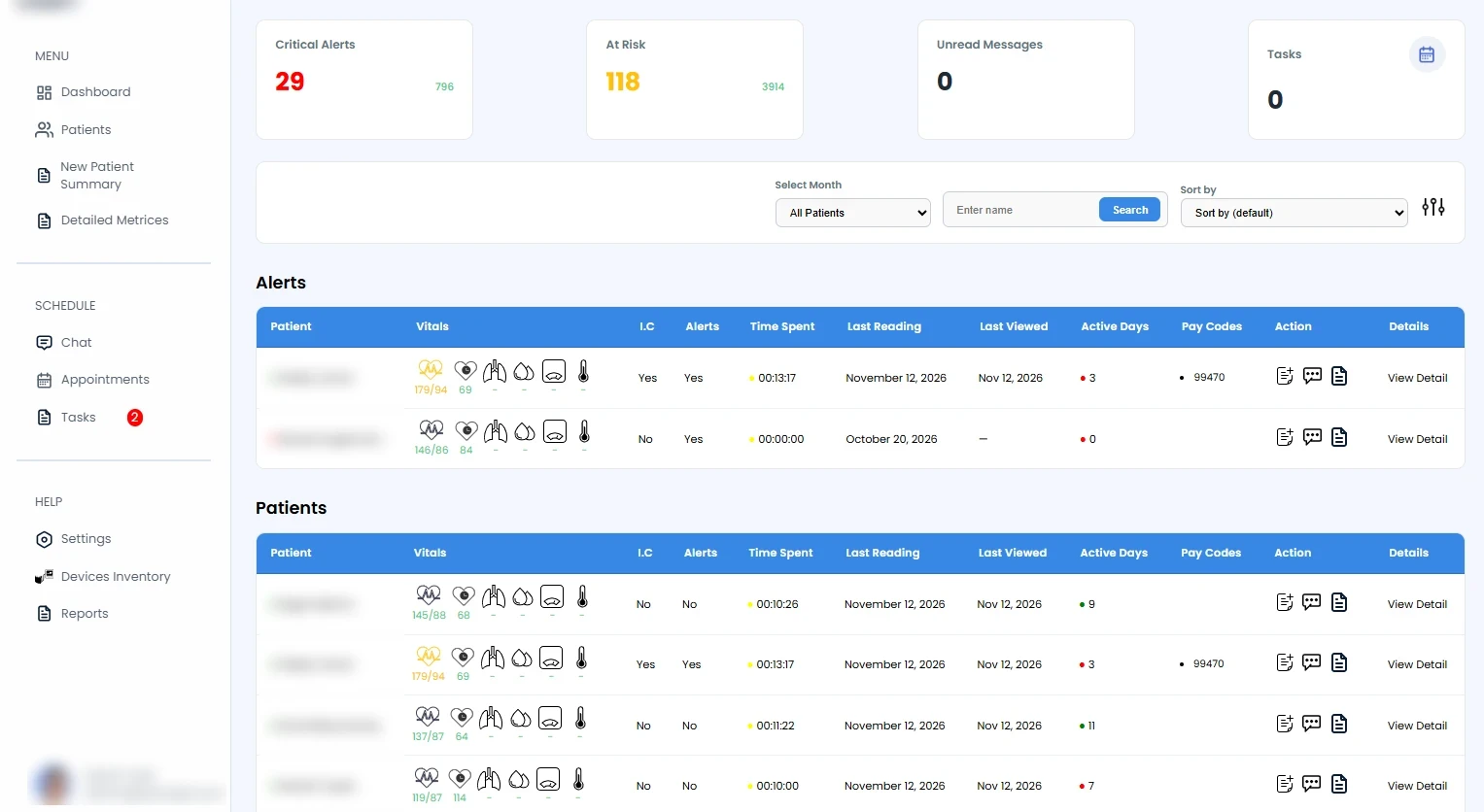
RPM dashboard
Every patient's vitals, on one screen.
The care team opens the portal to a live view: critical alerts and at-risk patients at the top, then each patient's latest readings, time spent and active days.
How it works
From a reading at home to a call from a nurse.
Remote Patient Monitoring
At home, with a connected device.
The device sends the reading to our server.
Doctors and nurses see it on the patient's record.
The system flags it to the provider or nurse.
A nurse or provider talks to the patient.
Chronic Care Management
Consent is recorded and the patient is placed on a care package.
The care team works through each patient and logs what was done.
Who was processed, who opted in, and who is still waiting.
Reporting
Reports for every part of the work.
Both platforms turn daily work into reports the clinical team and the practices can use.
Analytics
A Power BI dashboard for the whole team.
On top of the two platforms, we built a Power BI analytics dashboard. It reads the same database, so managers and team members can track everything in one place without asking anyone for a spreadsheet.
- Patient vitals and readings across the Remote Patient Monitoring program
- Alerts and at-risk patients, and how they change over time
- Patients opted in, processed and still waiting in Chronic Care Management
- The work done by each team member
- Reads straight from the Google Cloud database, so the numbers stay current
Built for healthcare
Patient data, handled with care.
Both platforms hold protected health information, so both are built to be HIPAA compliant.
- HIPAA-compliant platforms for both programs
- One shared SQL database on a managed Google Cloud instance, so there is a single record for each patient
- Consent recorded before a patient is enrolled
- Alerts go to the nurses and providers who run the portal
Tech used
The tools behind it.


Building software for healthcare?
We build secure platforms for care teams: patient portals, device connections, alerts and reporting.
Client details are anonymised. The screenshot is real, with patient names and staff details blurred.